Hollytree Morris Dancers
Victoria, British Columbia, Canada 1974-1984: a History by David Winn*
Also at http://victoriansquire.50webs.com/Frame.htm
AMERICAN MORRIS NEWSLETTER
VOLUME 68, NUMBER 2 [1984]
Notes from the Editors
AMN is proud to initiate a new feature section in our pages. The concept of “The History of Morris in North America” is to recount the process of how Morris dancing, in all its forms, was introduced, how it spread, and how it has developed across this continent.
The project was initiated in the Fall of I982 while I was on sabbatical in London, England. So while all the archives, diaries, letters of correspondance and lost unpublished autobiographies are found and analyzed, we start the series by recounting the more recent history of the establishment of today’s North American sides.
In this, our maiden presentation, we take note of one of our oldest, most western and most northern of sides — Hollytree Morris from Victoria, British Columbia. — J.C.B. [Jim Brickwedde]
************************
- David was our founding Squire, but sadly he passed away in 2014. His wife, Christine, is still an active dancer and much respected leader in both Hollytree and Saanich International Folks Dancers, which she and David alo co-founded – but that is another story.
- Missing from David’s history is that Christine secretly made a Forest of Dean jacket for David after their trip to England, and gave it to him as a Christmas present in 1973. Well, said David, I guess we are starting a Morris side (see the video interview I did with Christine in 2021 – Trevor Hancock, June 2024
- https://www.youtube.com/watch?v=3dWt_N17SlQ&t=9s
1 ~ Introduction
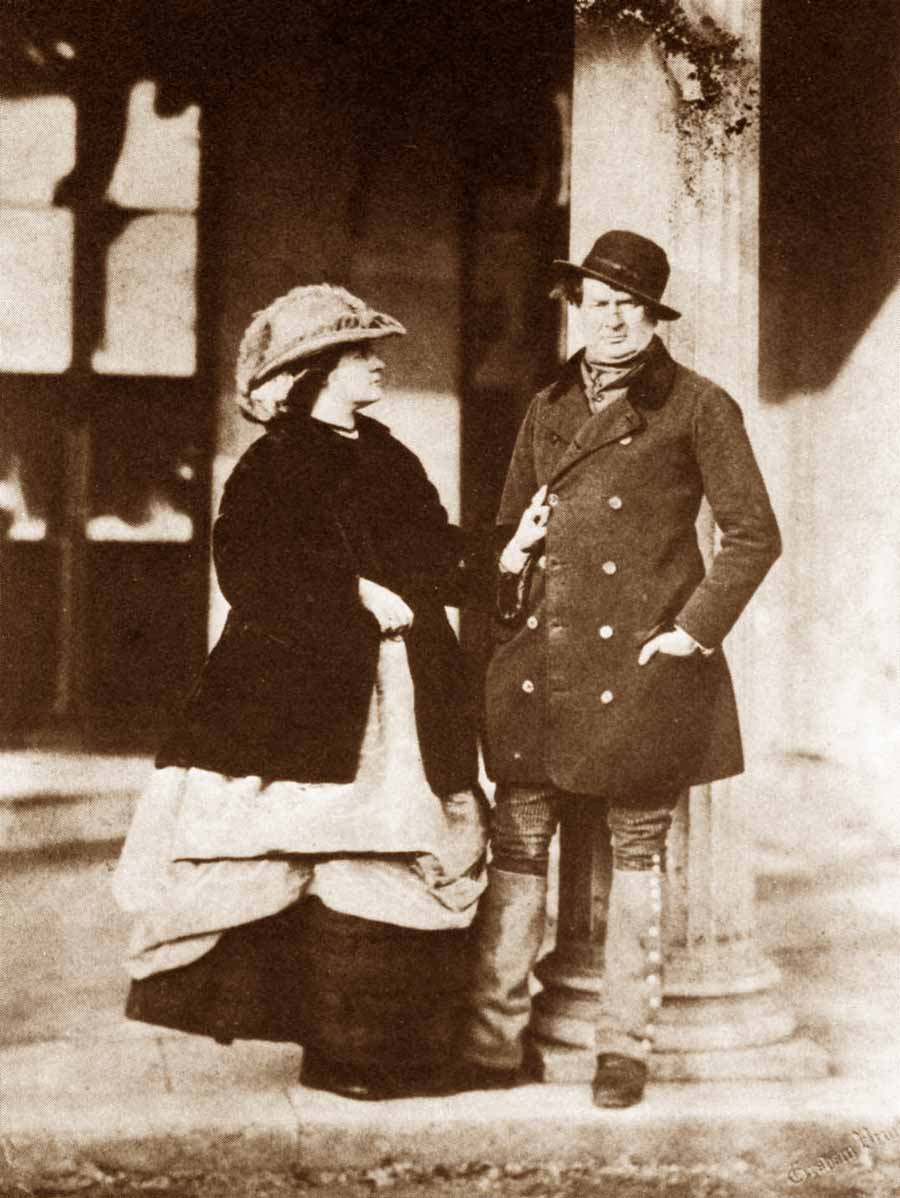
Actually, when I say “Victorian,” I do live in Victoria. And I really was, for a while, “Squire” ~ of a Morris Dance team, I mean. Admittedly neither I nor Christine look at all like the couple in the picture. They are William Thomas & Sophia Penelope Horner, Earl & Countess of Ilchester. By coincidence, a sister-in-law and a brother-in-law of my mother’s each had an ancestor in Ilchester, Somerset ~ so there is some connexion.
I have created this web site as a history of Hollytree’s first ten years, including the period before it took its present name.
I have copied in the following pages ~ in plain “sans-serif” typeface ~ the ten-year history I wrote in 1984 at the invitation of the American Morris Newsletter, who had embarked on a project of publishing histories from various Morris teams, starting with us.
I have also copied ~ again in plain sans-serif typeface ~ the report I wrote in 1978 on our participation in the folklore festival of St-Octave de l’Avenir in the Gaspé.
Memory can be fallible, and also different people pay attention to different things. Records written within ten years, however, are more credible than the memory after a lapse of two or three decades. For example, when I came across my report on St-Octave, I had no recollection after all these years of some of the information set down there in my own hand. (That’s the point of writing things down on pieces of paper.)
I have added ~ in this “serif” typeface ~ other memories and comments, and I have included a selection of photos ~ which themselves have in their turn aroused memories.
Contributions of more photos and memories from 1974-1984 are welcome, and I will do my best to accommodate them. Hollytree’s history after 1984 I leave to someone else to take on, as my hands are full; although for that undertaking, I do have some contributions available.
******************************
1973, thinking about Morris
Anyone looking for Victoria on the map will notice that our city ~ the capital of BC, but with a population only a fifth of Vancouver’s ~ is eccentric and insular. This geography is reflected in our Morris activities.
Victoria is a cosmopolitan city with numerous active ethnic clubs, many of which have dance teams. English traditions were not represented, however, and partly with the aim of filling this gap, my wife Christine and I decided to expand our involvement in international folk dancing and tackle dances of our native land. On a return visit to England in 1973, we obtained some literature and recordings from Cecil Sharp House. Using this sparse material, plus books in the public library, I reconstructed two Headington dances (inaccurately, as I later discovered).
1974 – Bean setting and other dances
From our folkdance club we recruited enough men for one side. Christine organized the wives in costume-making (the Forest of Dean multi-coloured patch vest, as worn also by the Beaux of London City); the other gear includes straw hat, long-sleeved white shirt, and white trousers; individuals choose their colours for ribbons on hats, arms, and bellpads, and pile decorations and souvenirs on their hats according to their own fancy.
We found ready-made jumbo-sized handkerchiefs in a local store, but in blue & white and red & white patterns, which hence became part of our standard kit. Frequent stick breakage caused interesting random effects at performances until my employer’s chief forester arranged a supply of superior specimens for us.
(He advised us to use a long-fibred species, I think some kind of maple, for strength, and on a company field trip they found for us a bunch of cuttings. So far they have lasted three decades, and they have a beautiful piercing ring, when held with a relaxed grip, and aimed at a meeting point for the clash, rather than swung like a golf club.)
Our first appearance was in 1974, a stage performance in a program of folk dances. Lacking a musician, we depended on recordings. For a couple of years we continued with occasional practices and performances. We did not exclude women, but few were interested in participating except as stand-ins; when they would wear the men’s costume.

1976, Bean Setting, Market Square, the Victoria Morris Men, two years after the team started. From left, Don, David Taylor, me, Valin Marshall)
1975 – Our sword dance, and more
In 1975 we were joined by David Taylor, an accomplished folkdance teacher who had just returned from contract employment in Kenya. While there, he had belonged to a Morris side started by another expatriate from England, and with this experience he was able to straighten out some of our problems of interpretation and styling, to add some more Headington material, and to introduce the Adderbury tradition.
We also took up longsword. Our resources did not include complete instructions on any one dance, but I did manage to stitch together sections from several dances to fit our recording of the Flamborouqh tunes.
At Christine’s suggestion we named the dance after Market Weighton, near her home city, Kingston upon-Hull.
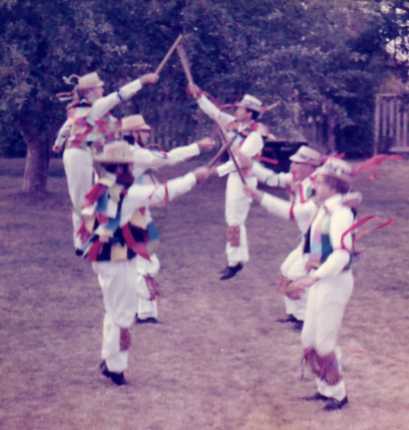
(Market Square, 1976 (also visible, Fred Carr and one unknown)
The swords, of fibreglass, I bought from a boating supplies store. I asked for eight three-foot sail battens. (That included two spares.) The storekeeper retired to a back room to cut them, but soon returned with a puzzled look, and enquired, what rig was this boat? So I explained.
Our costume was simply the Morris gear, minus hat, jacket, ribbons, and bells, plus a sailor’s cap, all very plain and not distracting the audience’s attention from the figures, and also allowing a quick costume change.
We performed the Morris dance and the sword dance, below, on the same occasion, on the Lower Causeway at the Inner Harbour, for the 1978 Captain Cook Bicentennial.
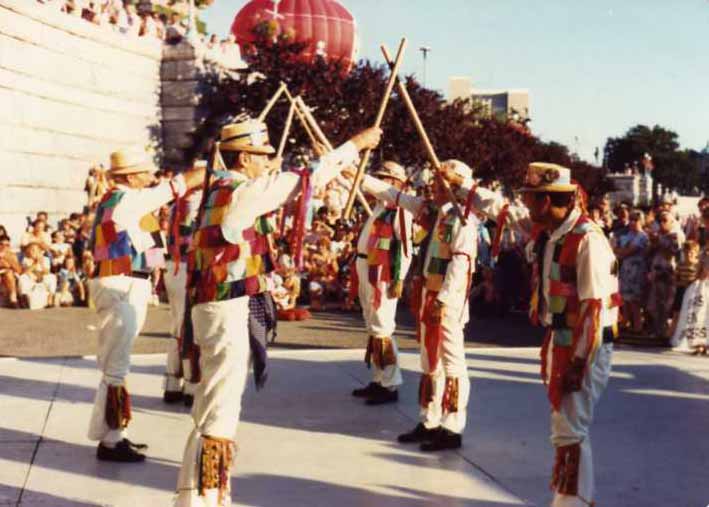
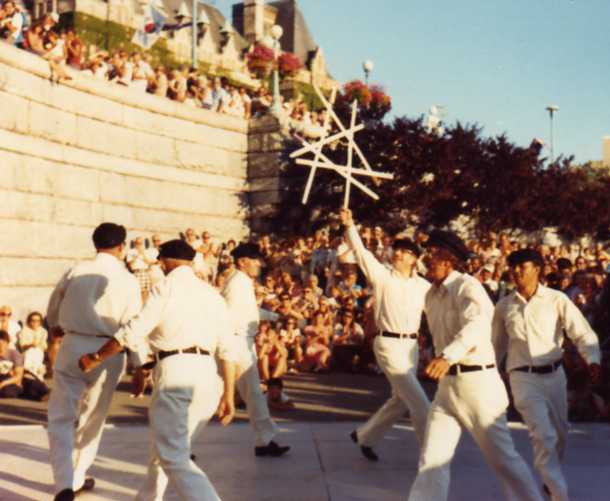
Our sword dance went down well with audiences. One visiting Morris dancer who knew sword-dancing said it was interesting in its similarity in one part to this dance, in another to that one, and I said, yes, it was interesting.
Sword-dancing demands coordination, of course, and I treated this training in teamwork as a bonus.
1976 – Our part in Montreal’s Olympic deficit
In 1976 we were galvanized into more energetic activity by being selected for the BC contingent to the Arts and Culture Program of the Montreal Olympics, on the recommendation of the Victoria Inter-Cultural Association, an umbrella organization for the ethnic groups. We took with us an accordionist whose background was Old-Tyme dance music, and considering the change in style needed I think she managed well. Other groups in the BC contingent included a traditional Chinese orchestra, some Punjabi dancers, a Doukhobor choir, and a Tahitian dance group; I mention these because our Morris activities are seen here to constitute one element in the so-called intercultural mosaic that is officially encouraged by Canada’s Multiculturalism policy.
The Punjabi dancers were spectacular, their highlight coming when they danced in vertical pairs, one dancer’s feet on another’s shoulders.
Groups not mentioned above included a family of Spanish dancers (of Victoria), and a choir of Korean girls. Probably I have forgotten someone.
We might have used recordings (other groups did), but the BC contingent leader, Frances Fridge of the Canadian Folk Arts Council, said they needed a musician for the National Anthem, and Grace (the musician they selected) could take care of our music too.
We took the ferry from Victoria to Vancouver, and stayed the night at the Sandman, by the bus depot. We went to some hall or gym for a rehearsal, not in costume, and I recall feeling discomfort that we did not appear at our best.
Next day we flew to Montreal, and were taken by bus about an hour’s ride from the city centre to an orphanage (the residents being away on vacation) in the East End. We were given breakfast vouchers for a nearby café, and as we had no choice of eating-place they gave priority to their regulars.
The groups were divided into two tours, Chinese orchestra and Doukhobor choir in one, the rest of us in the other. Our tour’s show lasted about an hour. We had ten minutes or so for our Morris.
From Monday to Friday our tour was to give five shows, one for each of three days, two shows one day (although one of those was dropped), and one day free.
We had to be dressed up and ready for the bus, but often the bus was not ready for us. Then there was the hour’s drive into town. There were various locations, including a shopping centre.
After the show we had time for lunch and looking around, and then we waited for the bus, which was sometimes late.
One afternoon we stayed downtown for dinner, us and some others of the BC groups. The restaurant made a single multi-page bill for all of us, with predictably uneven results when we tried to work out our dues. People have long memories about money and fairness.
August 1976: a postcard from Leilani of the Tahitian dance group:
Hi, Uncle Morrises (Ken, Dave, Fred, Dave T, Don, & Doc), & of course Auntie Morris, Having a good time here in New York. Hope you all had a good trip home. Thanks so much for being so nice to us in Montreal, and also being our “chaperones.” Hope we weren’t too much trouble …
When we met they decided to call each one of us “Uncle Morris“, except for Grace, our musician (“Auntie Morris“), and Valin, who they discovered had a PhD, so he became “Doc Morris“. Their naming convention we accepted in the spirit of multi-culturalism. And the chaperoning part was an enjoyable responsibility, diligently performed.
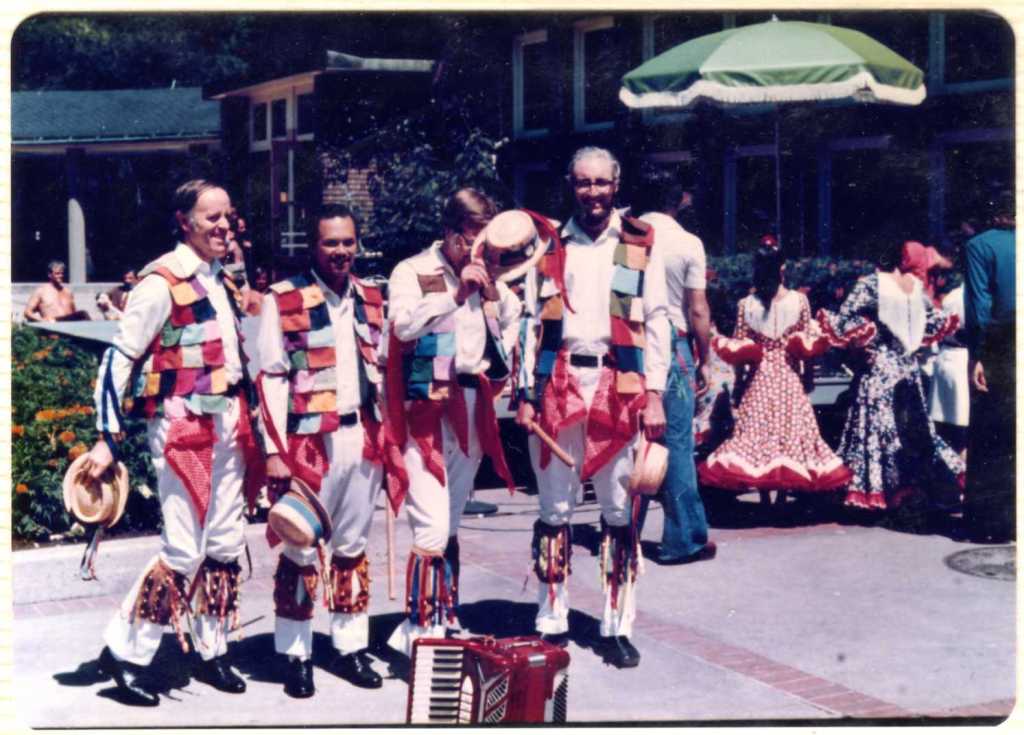
Montréal Olympics, 1976: L – R – Fred Carr, Val Marshall, ???? and ????
1978 – St-Octave de l’Avenir
After Montreal, we relapsed into occasional practices and performances, until 1978 when we were invited (again through our ICA connections) to represent BC at a folklore festival on the Gaspé, the circumstances being similar to those in Montreal but on a much smaller scale.
The third annual Festival de Folklore de St-Octave-de-l’Avenir was held June 29-July 2, 1978.
St-Octave-de-l’Avenir is an abandoned village (now reduced to the church and two adjacent buildings) in the hills of the Gaspé peninsula, overlooking the St Lawrence estuary and about 10 miles inland.
The festival is run by a local organization (the Corporation du Festival de Folklore) based in Cap-Chat, the nearest town, with help from the Canadian Folk Arts Council.
The CFAC handled the show presented on each of the four evenings on an outdoor stage, and dealt direct with us on the preparatory arrangements for the trip.
Other groups (all dancers) taking part in the stage show included local Indians; Nordfolk (Québecois, from Sept-Iles); Evangeline (Acadian, from PEI); Polish and Egyptian (Montreal); and Philippine and Italian (Winnipeg). So we had travelled the furthest!
The festival also included folk-music performances, arts-and-crafts displays, and various side-shows, stalls and kiosks. Reported total attendance figures ran into the tens of thousands, and certainly after the Thursday the village was continually packed with people.
The village was created during the 1930s Depression, as part of a back-to-the-land strategy. “Octave” honoured Msgr Octave Caron, a local churchman, one of the project leaders; “de l’Avenir” (of the Future) expressed a belief in better times to come.
But the land was marginal for agriculture; there were setbacks, including a major fire; and after forty years the settlement was closed down by the government.
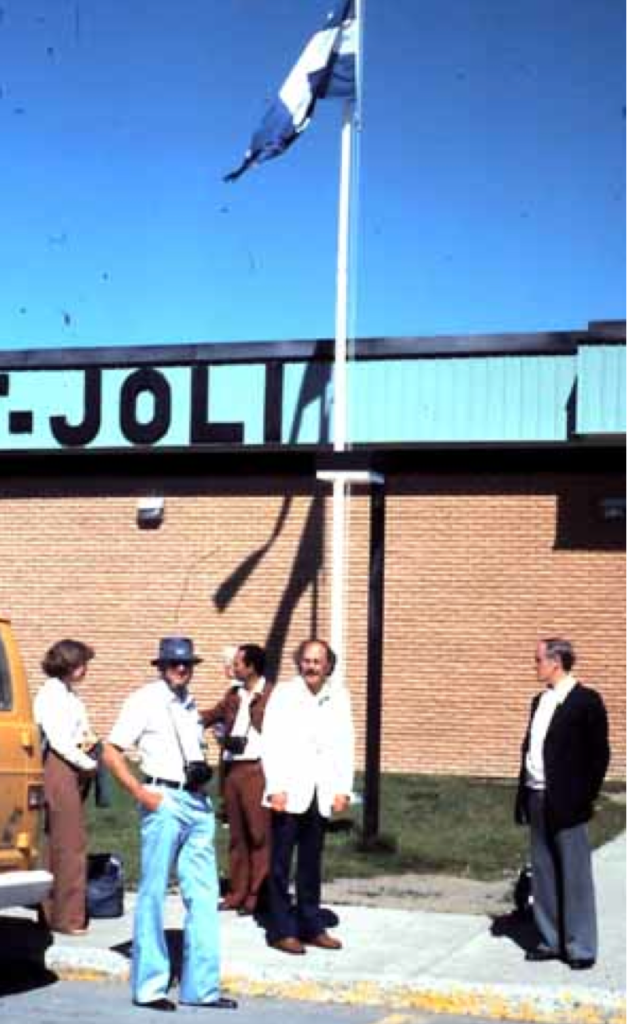
We arrive in travel clothes at Mont-Joli airport: Dora Leigh, Don, Valin, Tom, Fred.
Again we had a team of six dancers, almost the same people as for Montreal, except that David Taylor was working abroad, and Tom Barnes had joined us.
I asked at Tempo Trend Studios (where our son and daughter took music lessons) whether they knew a musician who might play for us, and they suggested Dora Leigh. We learned she had won a BC award for accordion, and had played as a guest soloist with the Victoria Symphony. I felt guilty about asking her to introduce some jerkiness into her playing of the Morris music, but she was both understanding and adaptable, and it was a pleasure for us to work with her on the practices and performances.
Accommodation was in single rooms (comfortable and clean) at a school in Ste-Anne-des-Monts, near Cap-Chat. Breakfast was provided in the school cafeteria, and other meals mainly in St-Octave itself. The food was good.
The local festival committee were extremely hospitable, arranging for the performers a reception / cocktail party on Thursday; a picnic at a member’s country house on Friday; a presentation of mementoes and buffet supper on Saturday; and a farewell lunch with local dishes on Sunday.
Though it was summer, it got cold on that hillside where we performed. After our first evening, they arranged some trucks with canvas covers, and heaters, for us to shelter in. The audience mostly wrapped themselves in blankets. They didn’t seem to be very numerous, and Valin (who feels the cold and had worn pyjamas under his Morris costume) thinks many of them were other performers.
We had expected to do a couple of Morris dances, and our sword dance. The morning after the first show, the director called in each of the dance group leaders in turn, and told us the show was too long.
To me he proposed we do the Sword Dance, and drop our other dances. From his show-biz viewpoint, that made sense, because the sword dance was unusual and dramatic. For us, however, it wouldn’t make sense for a Morris team not to dance Morris. So I agreed to shorten our program ~ but we actually cut out our Sword Dance for the rest of our performances, and luckily he did not complain.

(Picnic, Valin, Ken, unknown, Dora Leigh, Don, David)

Bus to St-Octave, by row, Valin & David; Tom & Ken; Don)

At the picnic put on for the performers, including the Italian dancers, Philippine dancers, & some others:
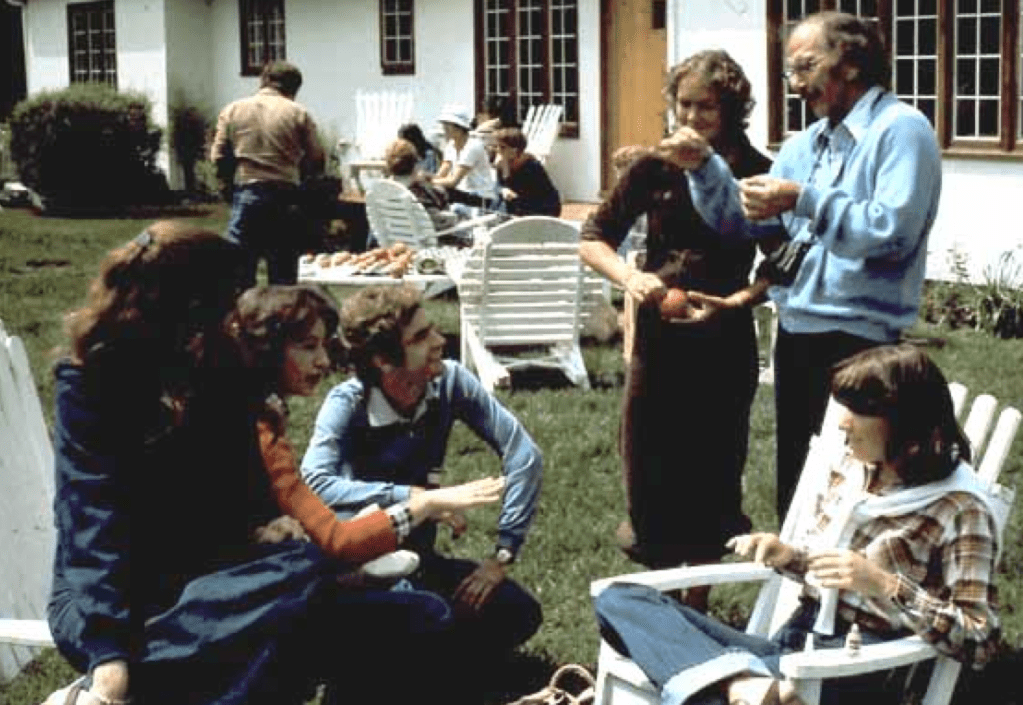
The picnic location was sheltered, & warm in the sun; the Italian dancers, & unknown young man & Tom keeping them company:

Even in summer the weather can be chilly. Cap-Chat, the lighthouse, & Fred looking after the Italian dancers:
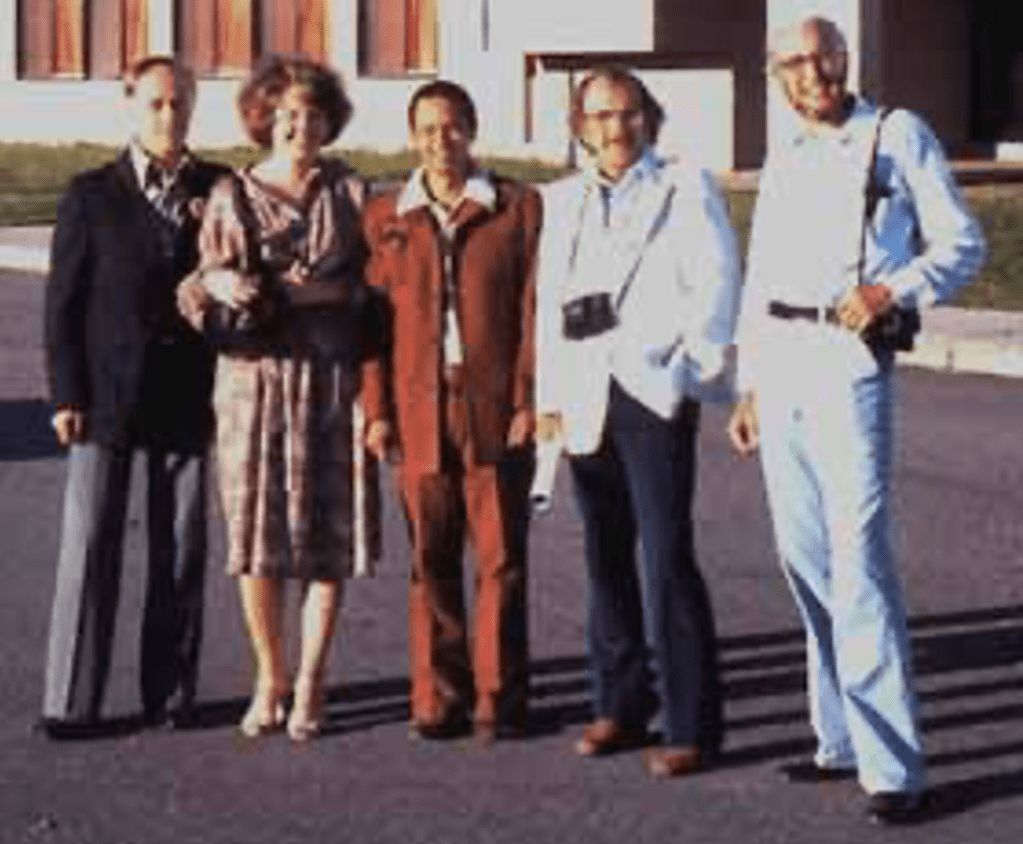
Ste-Anne-des-Monts: Fred, Dora Leigh, Valin, Tom, Don
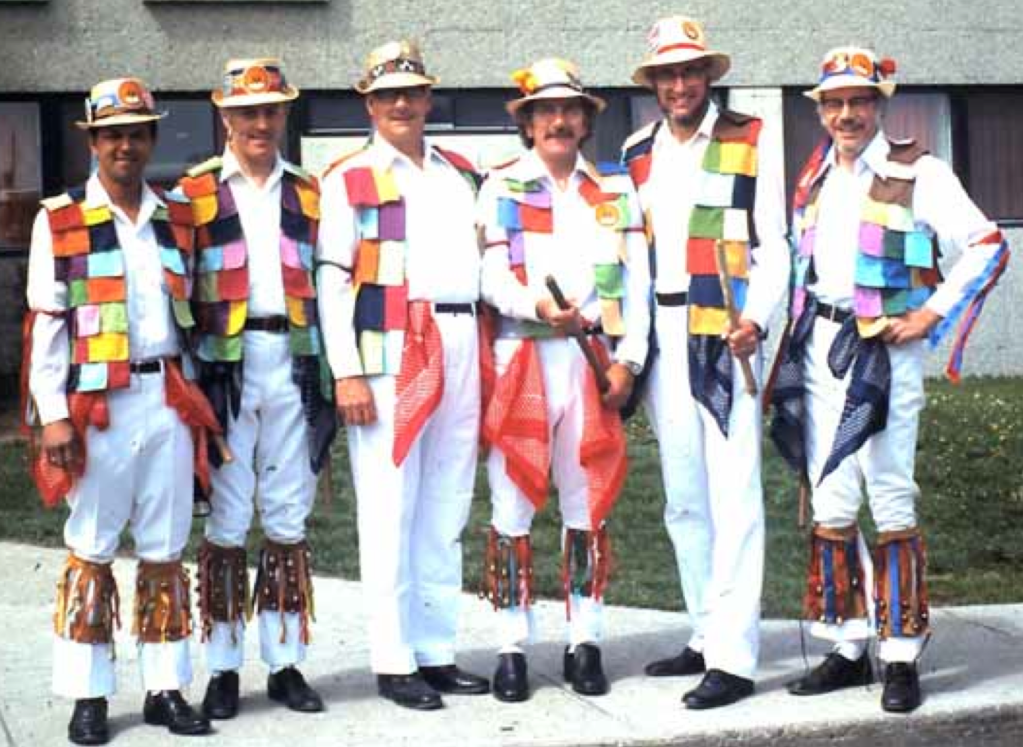
Valin, Fred, Ken, Tom, Don, David (Dora Leigh probably behind Fred’s camera), awaiting the bus to St Octave; dressed up except two without bells (considerate of their blood circulation), & my laces dangling. Note the deliberately random red or blue handkerchiefs; short sticks visible; I think we were using a long canvas bag for the long sticks:
1978: Pomfret visit Victoria
Our return to Victoria was swiftly followed by the arrival of the Pornfret side from Pontefract, Yorkshire, a team specializing in Bucknell. Their trip was noted in AMN 11.3 (Oct ’78), and was described more fully in The Morris Dancer, Issues 4 and 5 (Aug and Nov ’79). I will just add that since then. there have been individual visits in both directions.
Pomfret had a horse, two-legged, with a superstructure for its head, making it tower over everyone. Spare dancers took a turn sometimes. They had a Fool (Geoff), dressed distinctively, carrying a Union Jack on a stick over his shoulder, announcing the dances (he was a singer, and his voice carried clearly), and mingling with the crowd and accepting money (“not for beer, as is traditional, but to pay our air fares home. Thank you!”)
We arranged billets for them, and they stayed a week, getting better collections here than in other parts of western Canada they had visited. They entertained us with their singing, particularly Geoff, and Tony the Squire.
Geoff subsequently returned as an immigrant, and married and settled down. I last saw him as a guide and commentator on a TV travel program from the Maritimes.
During Pomfret’s stay we met Pat Thompson, recently arrived from Toronto where she danced with Green Fiddle. Pat later organized a women’s side, including several of the Morris wives, and also found us a permanent musician, Andy Jensen (who plays several kinds of squeeze box), from among the folk music community.
Also in 1978 I made contact with the Morris Ring. Mike Garland (the Bagman) was very helpful in providing leads, whereby I was able to augment our library and build up a collection of Letchworth’s tapes.
1980: Birth of Hollytree, a mixed side
In 1980 the Victoria Morris Men and the women’s side formally joined forces to become the Hollytree Morris Dancers, a name chosen for two reasons: the species’ ancient symbolism, and Victoria’s holly-growing industry.
The women’s costume, green corduroy knee-breeches and white blouse, was augmented by a vest in a small floral pattern on a black ground, with red edging and, on the back, a holly tree design and the words “Hollytree Morris” in white letters.
The formal creation of a club made us eligible to apply for financial assistance from the BC Cultural Fund, which in turn enabled us to rent school premises for regular practices. At the same time we began a log of performances, to support future grant applications.
During 1980 we began adding Bampton dances to our repertoire, following my attending the Mendocino country dance camp.
In 1981 we were invited to the BC Folkfest, held in Prince Rupert.
Also in 1981 some members formed a separate group, preferring spontaneous dance-outs, rather than our planned performances, some of which happened through our Inter-Cultural Association connection.
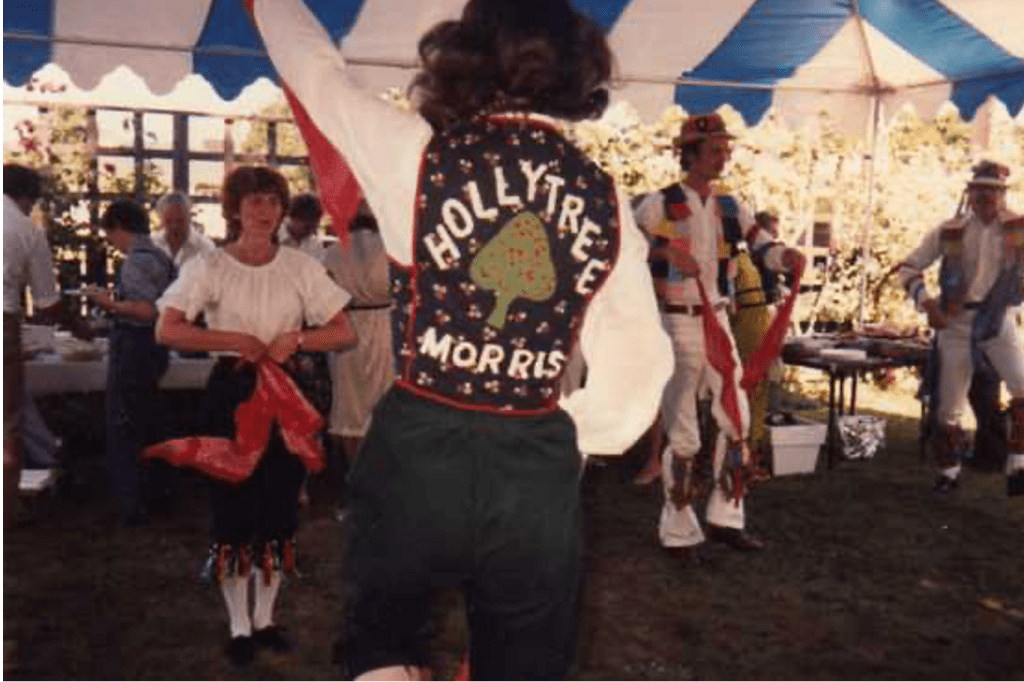
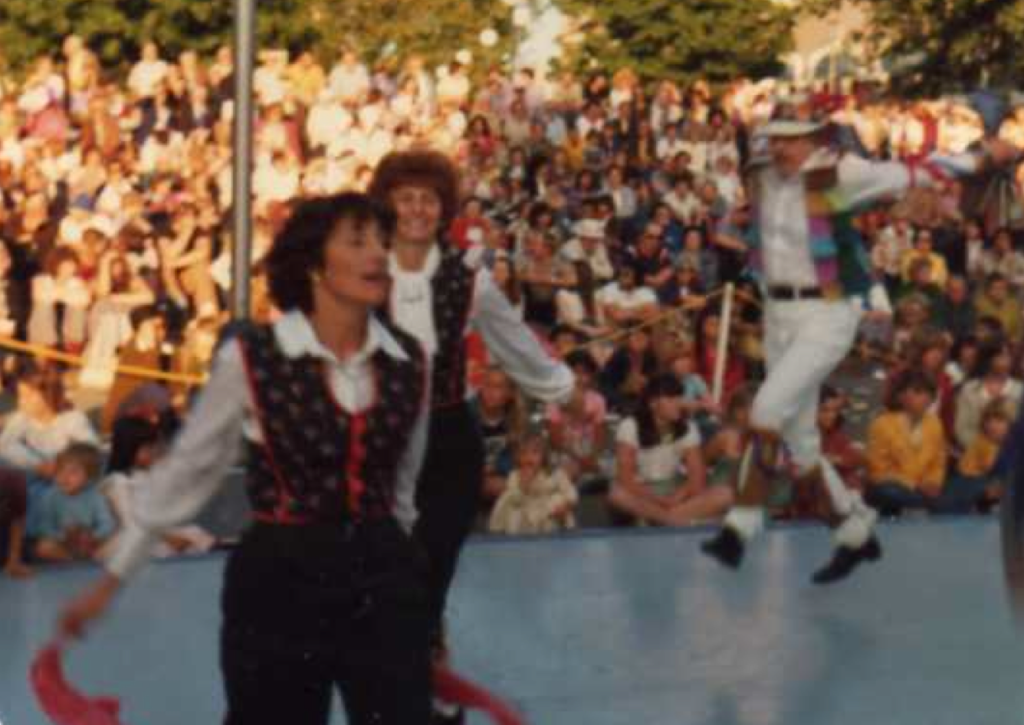
1981:
Folkfest, Bonny
Green
Garters
1982: We become equestrian
In 1982 I again went to the Mendocino country dance camp, and brought back some Bledington dances.
1982 was the year we acquired our hobby horse, donated to us by a senior citizens’ group in Vancouver who had been performing Morris for about a decade and wanted to try something different.
(This single sentence generated twenty-four years later a stimulating exchange of emails with Norman Stanfield, described later in this page.)
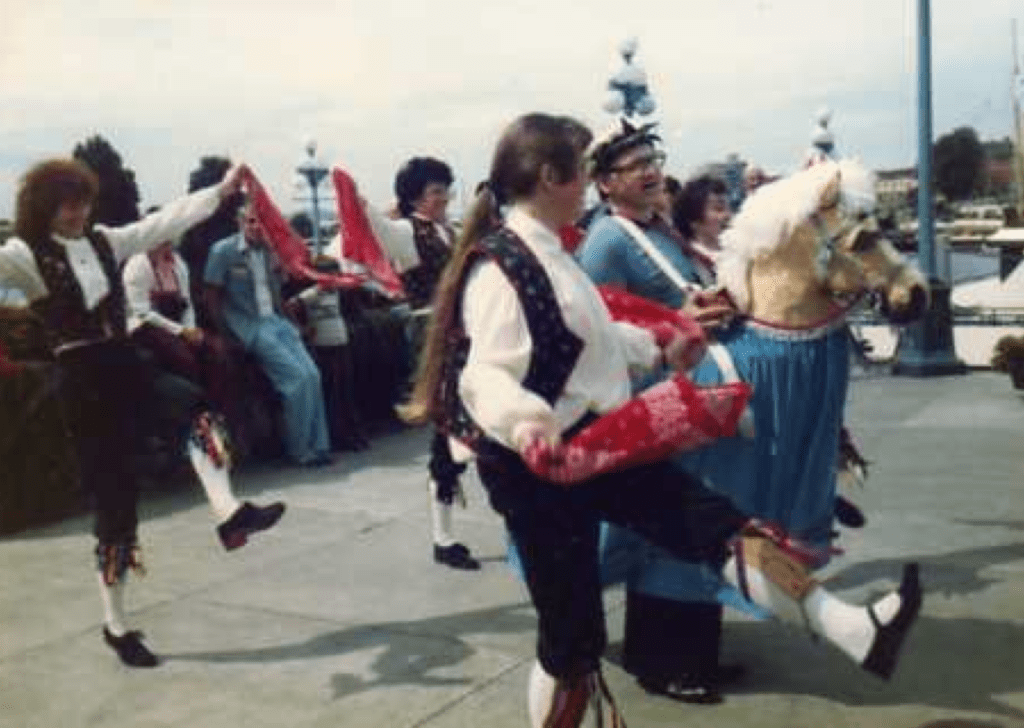
1982, from left, Christine & Rosemary; Julia, Hank with the horse, Bonnie
Most of our members have families and a corresponding shortage of time to attend to correspondence and administration, one effect being that we have made few attempts to contact other groups in the Pacific Northwest.
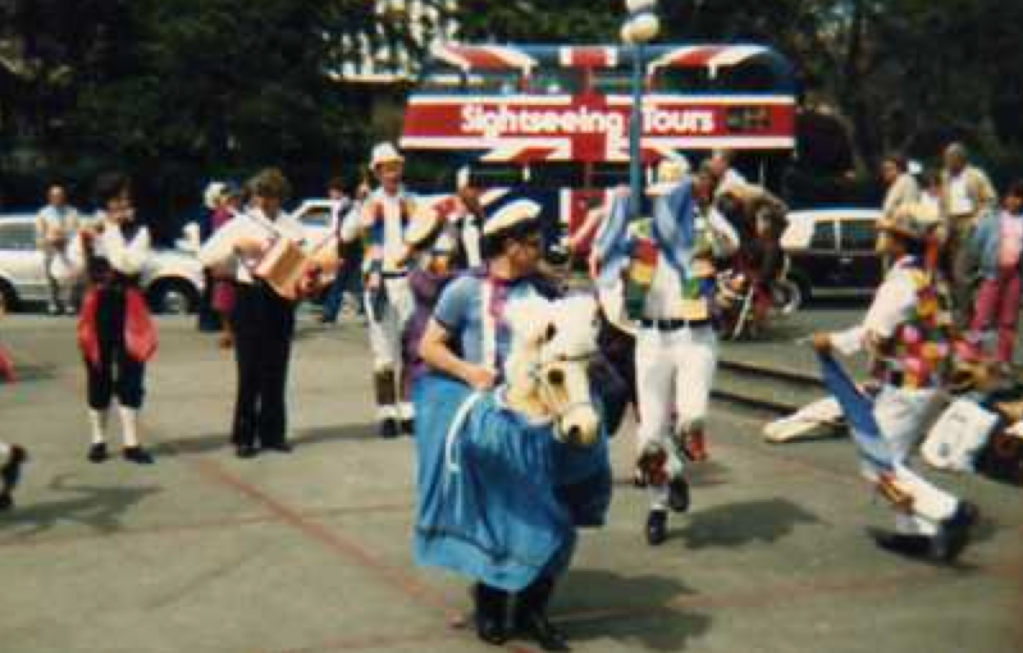
In 1980, however, we hosted Gasworks Morris from Seattle; and for the ICA’s Folkfest in 1983 we put on joint performances with visitors from the Vancouver Morris Men and Madcap Morris from Seattle, plus Eric Foxley from Nottingham Foresters Morris Men (over here for a summer teaching assignment at the University of Victoria).
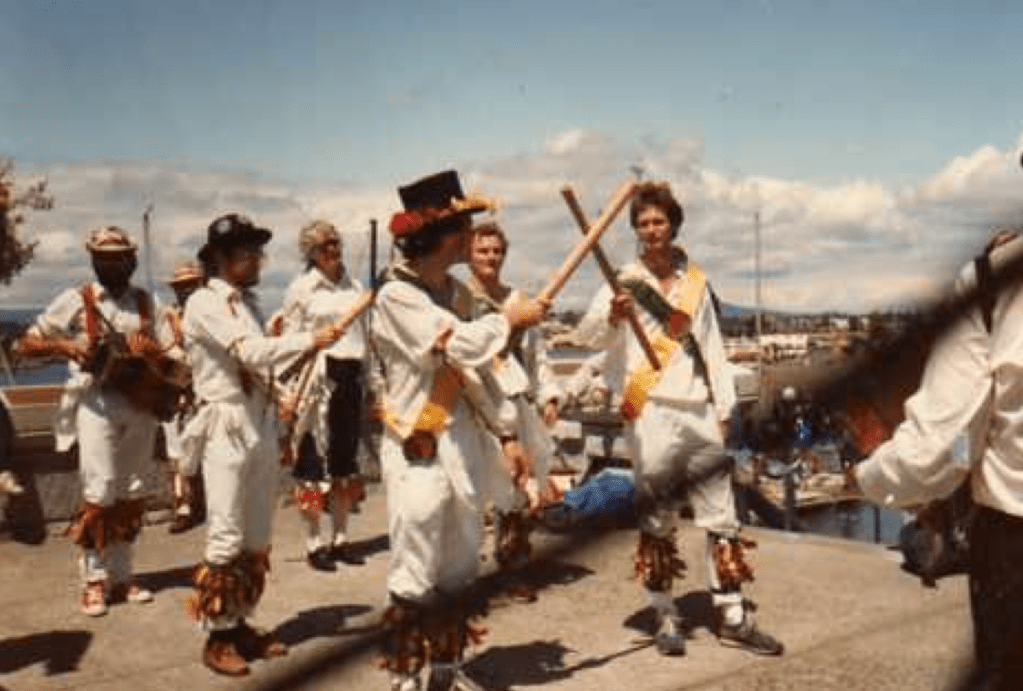
1983: Vancouver Morris Men
1984: Conclusion of this 10-year history
Our log for 1983 shows 15 performances, 8 indoors (TV, music festival, church social, senior citizens’ centre, hospital, retirement home, department store, private club), and 7 outdoors (Harbour Festival, Folkfest, and five informal dance-outs in various open spaces).
We dance mixed; if we had more members we probably wouldn’t, if only because of the difference in costumes.
Shortage of members has also meant that we cannot spare any above-average dancer to become a Fool.
Current traditions are Headington, Adderbury, Bampton, and Bledington. I realise that to some extent our style is peculiar to ourselves, partly through accidents of interpretation and also more recently from creative experiments with new variations. In keeping with our general level of ability, we avoid some dances that seem too difficult. Our cumulative repertoire, including what we have forgotten, averages just over two dances added each year.
We practise on Monday evenings at Doncaster school (formerly at Uplands school); during the summer holidays we practise less regularly on members’ lawns. On an exceptional night we get a dozen out, almost our total membership, some of whom have been with us for most or all of our existence.
Most of our people are in their 40s and 50s, and cracks about advancing years are becoming more common: after one performance at a hospital, we had a roll-call to check that no one had been lost in the geriatric ward.
One thing, about vigour, athleticism: I don’t claim we were ever strong in those qualities, and frankly I have envied some dancers their amazing leaps; some of us, however, have lasted quite well, and it’s good to retain a form of physical exertion into the latter years. Some people have had both, the stupendous leaps in youth and the continued energetic dancing late in life; they are lucky.
We had two big trips, Montreal in 1976, and Cap-Chat in 1978, unrepeatable, because Morris dancers are no longer scarce, as we were then; and because money for arts is scarcer than it was then; as our economy has grown, private wealth has expanded while public wealth has diminished.
Each time we were with a diversity of ethnic performing groups (mainly dancers). I found this congenial, partly because performers generally appreciated the performers of other groups for what they were. My experience with member groups of the Inter-Cultural Association of Victoria has been similarly favourable.
When we perform with one or both of the other local Morris groups, Island Thyme and Quicksbottom, we have an opportunity of catching up on gossip with people we see infrequently, plus the advantage of conserving energy and prolonging the performance through taking turns in a rotation.
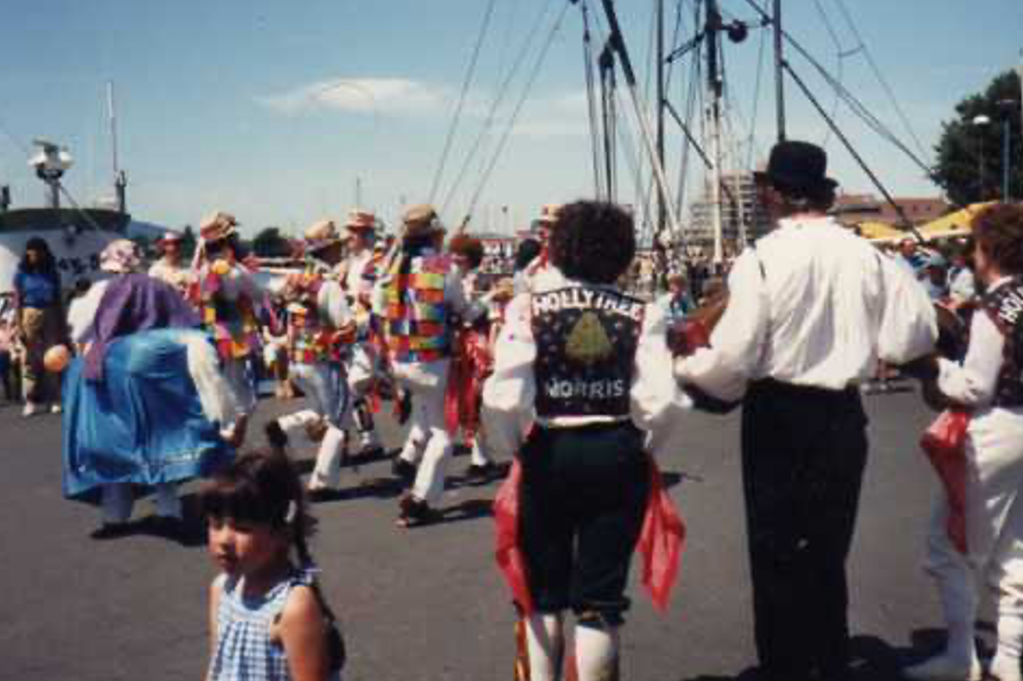
Harbour Festival, 1983
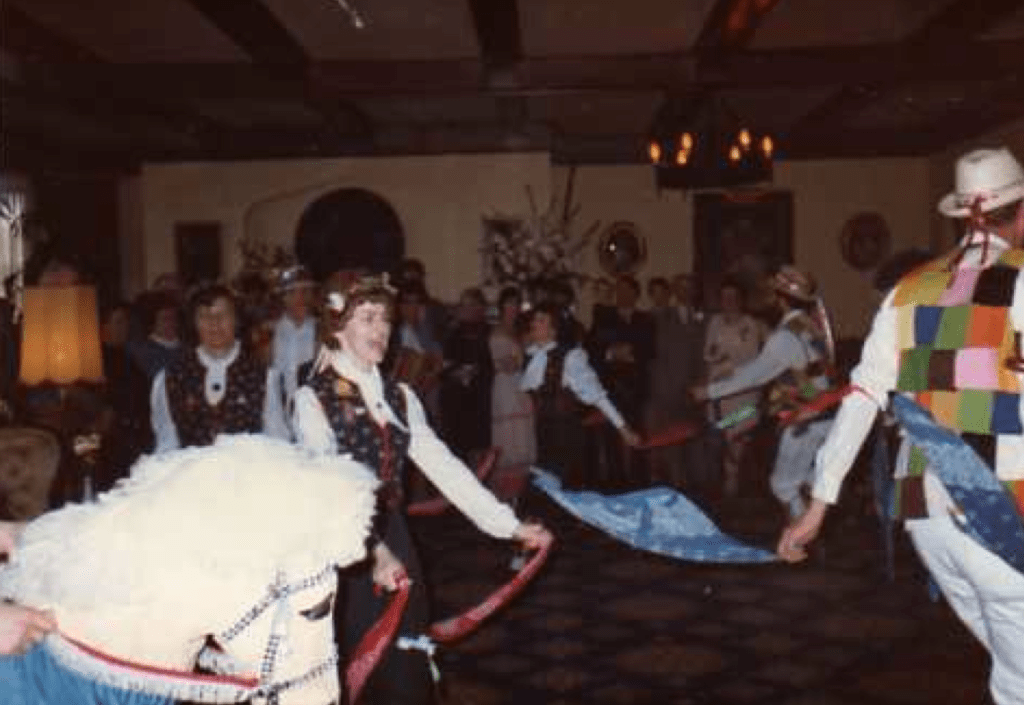
1984: Helen & Fred’s wedding, Oak Bay Beach Hotel
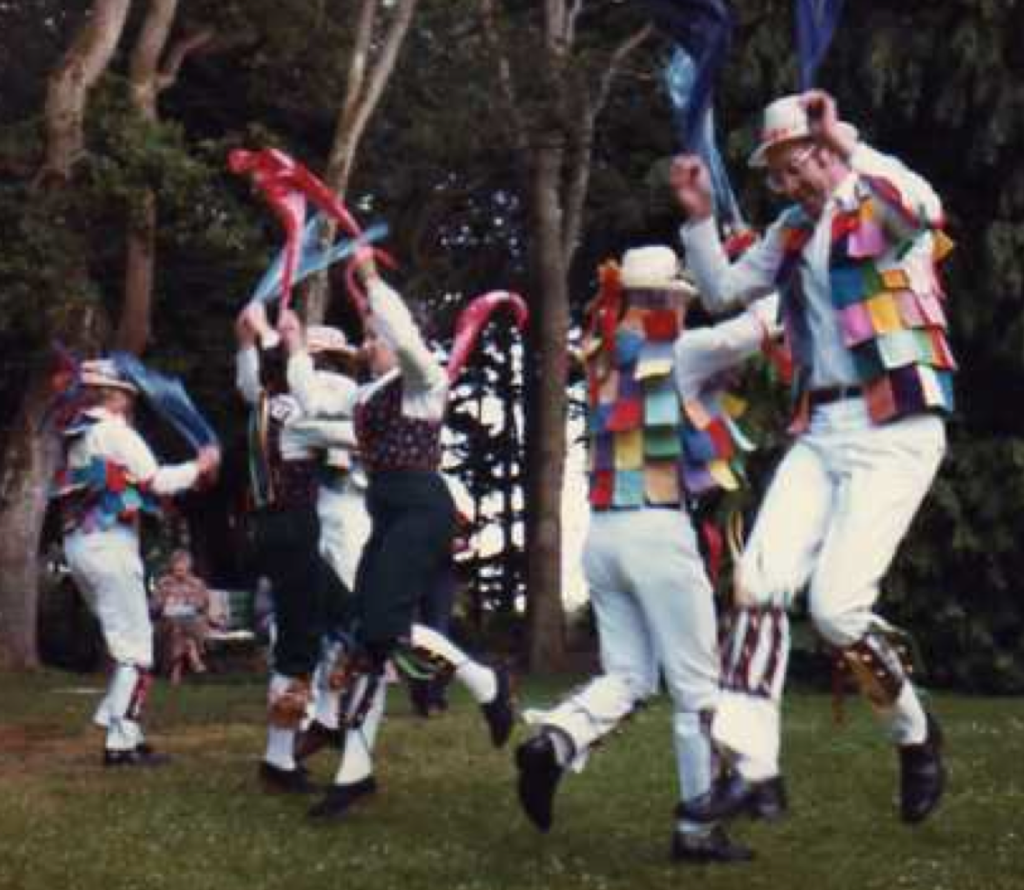
Beacon Hill Park, 1984

Beacon Hill Park, 1984
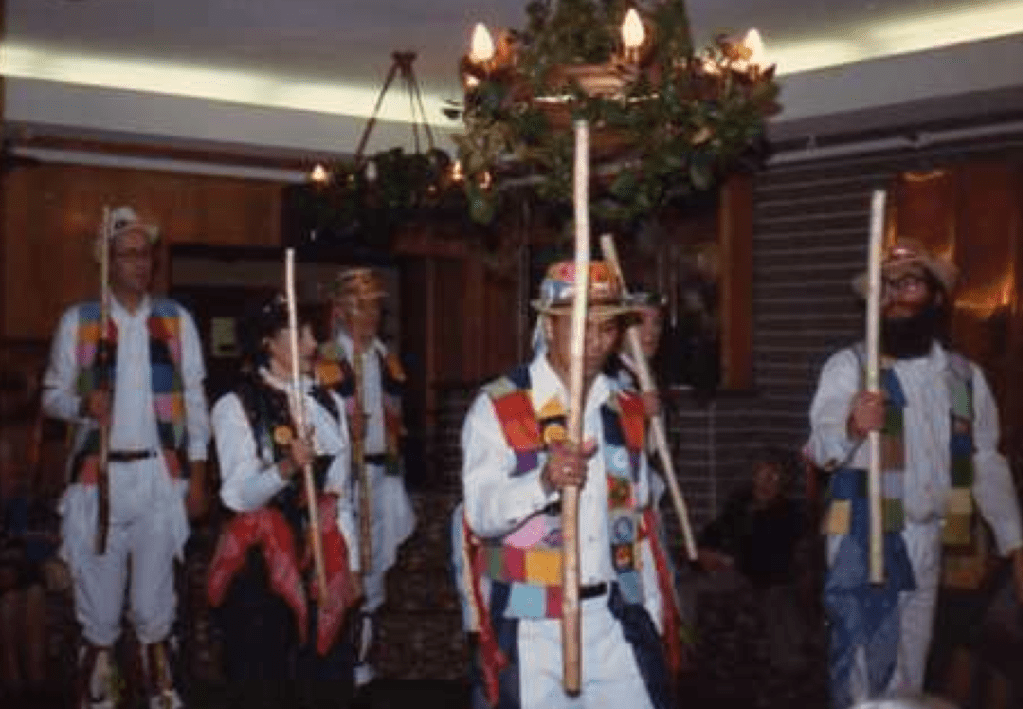
1984: Glenshiel Hotel, John Carver leading
 Hollytree Morris Dancers